

The complete guide
How to Choose a Countertop Wine Rack That Actually Fits Your Kitchen
The problem with bottles on the bench
Wine collects. It is not usually a decision. Someone brings a bottle to dinner, you pick up two on special, there is the good one you are saving. Before long there are bottles behind the kettle, one in the pantry lying on a bag of rice, another standing in the corner where it catches the afternoon sun.
None of that is a disaster, but it is untidy and it is slightly risky. A standing bottle on a crowded bench is one elbow away from the floor. A bottle on its side on a smooth shelf rolls the moment you move something near it. And when you want a particular bottle, you end up hunting.
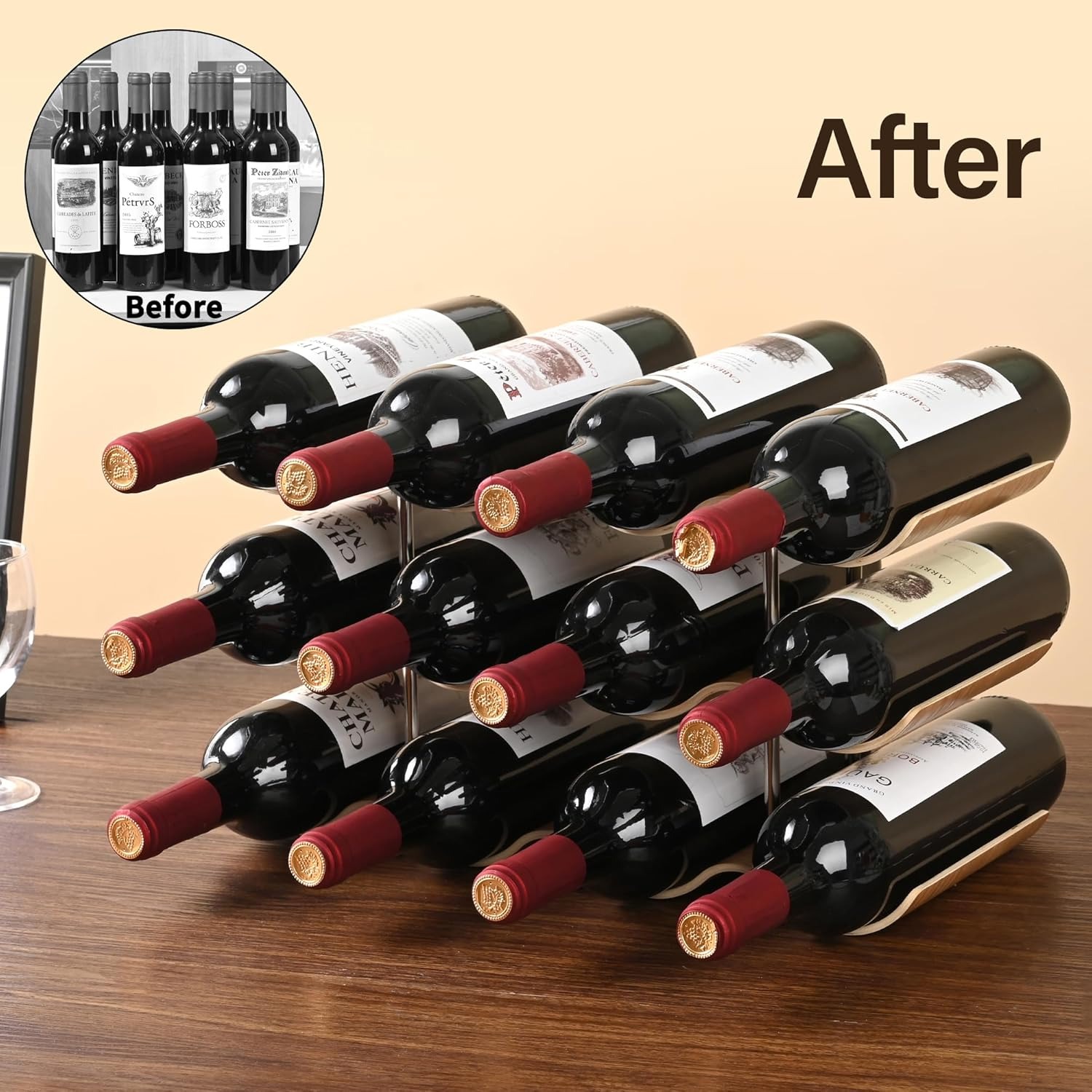
A countertop rack solves a small problem well. It gives the bottles one address. You can see what you have, reach the one you want, and get your bench back.
How this rack works
The design here is simple and it hinges on one idea: curves instead of flat shelves.
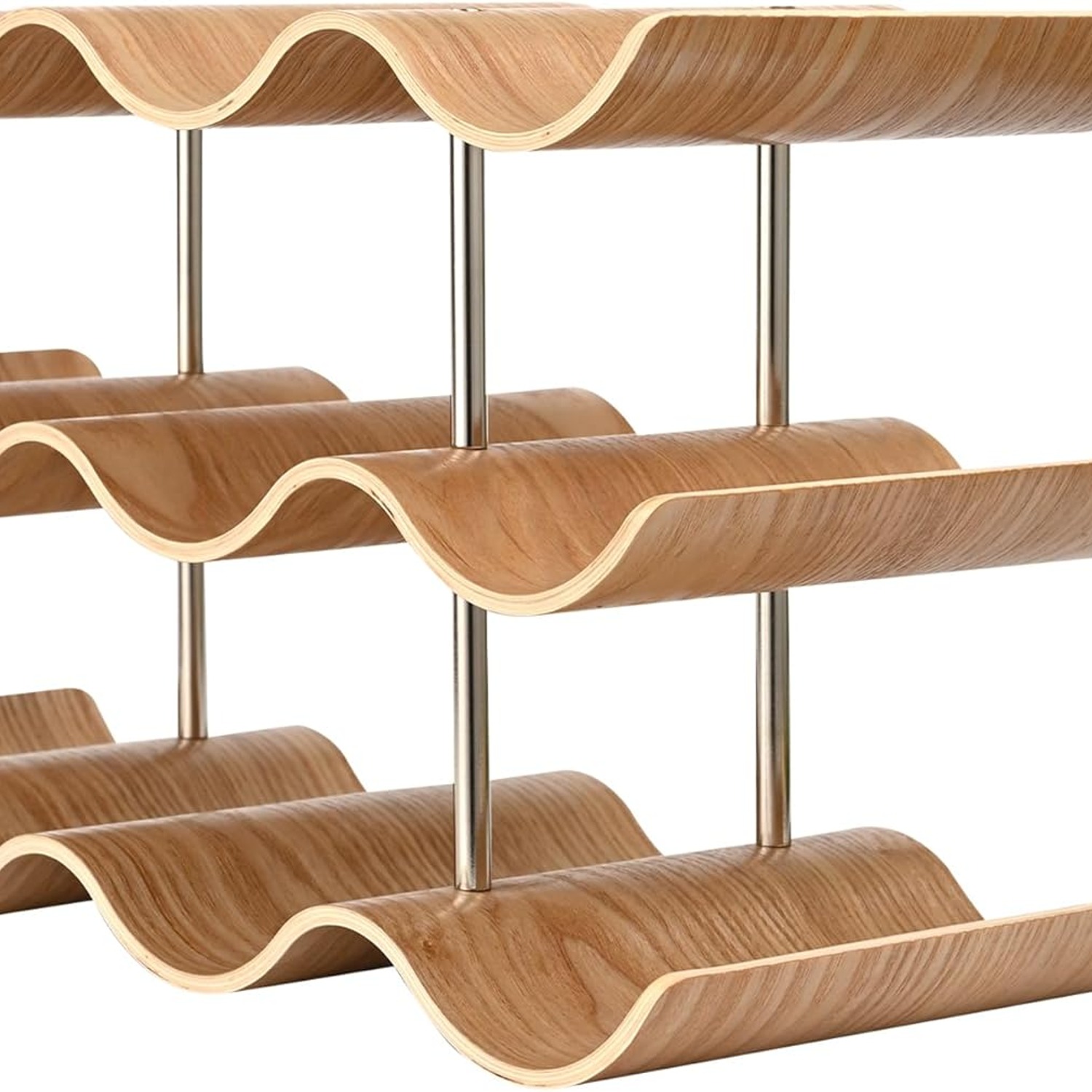
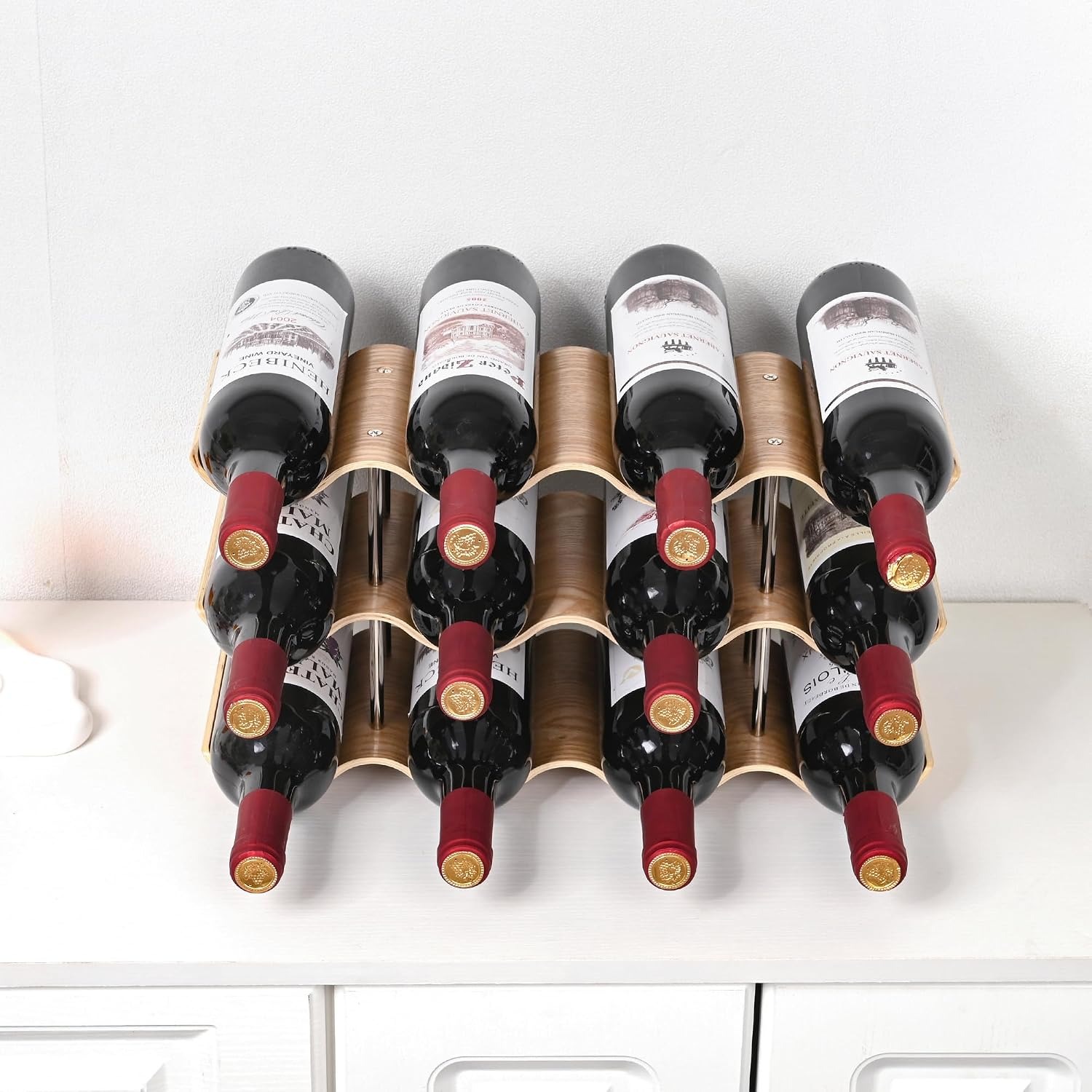
Three timber boards are pressed into a wavy profile, so each board is a run of gentle hollows. Stack three of those boards with metal struts between them and you have a 3 tier wine rack where every hollow is a bottle cradle. A bottle set into a hollow has nowhere to roll. It settles in and stays put, even when you slide the whole rack along the bench to make room for a chopping board.
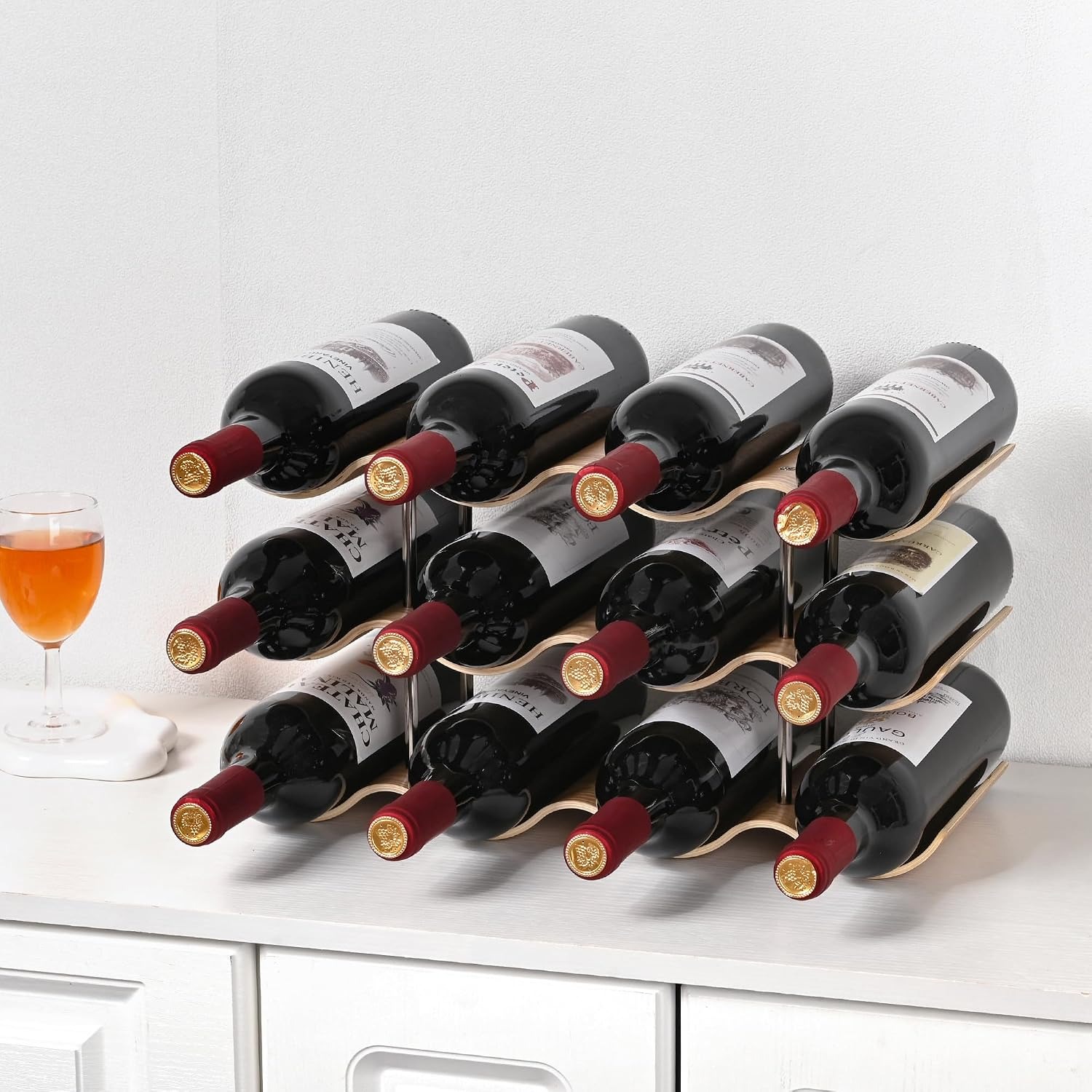
Capacity is twelve bottles. The two lower tiers carry eight standard bottles between them. The top tier has four slots that are wider, which is where the awkward bottles go: sparkling with its heavy shoulders, the occasional magnum, the chunkier New World shapes that refuse to fit anywhere sensible.
The struts matter more than they look. Eight silver double-pass nut struts join the boards and keep the frame square. Without them, three loose boards would flex. With them, the rack stays rigid under a full load of glass.
Assembly is quick. Three boards, eight struts, eight Phillips screws, one printed instruction sheet. The only thing you need to supply is the screwdriver, which is not in the box.
Who it suits
This rack is aimed at people who drink their wine rather than cellar it.
If you keep between six and twelve bottles on hand and work through them over weeks or months, a tabletop wine rack is exactly right. Everything is visible, nothing is buried, and you are not walking to a garage cellar to grab a midweek bottle.
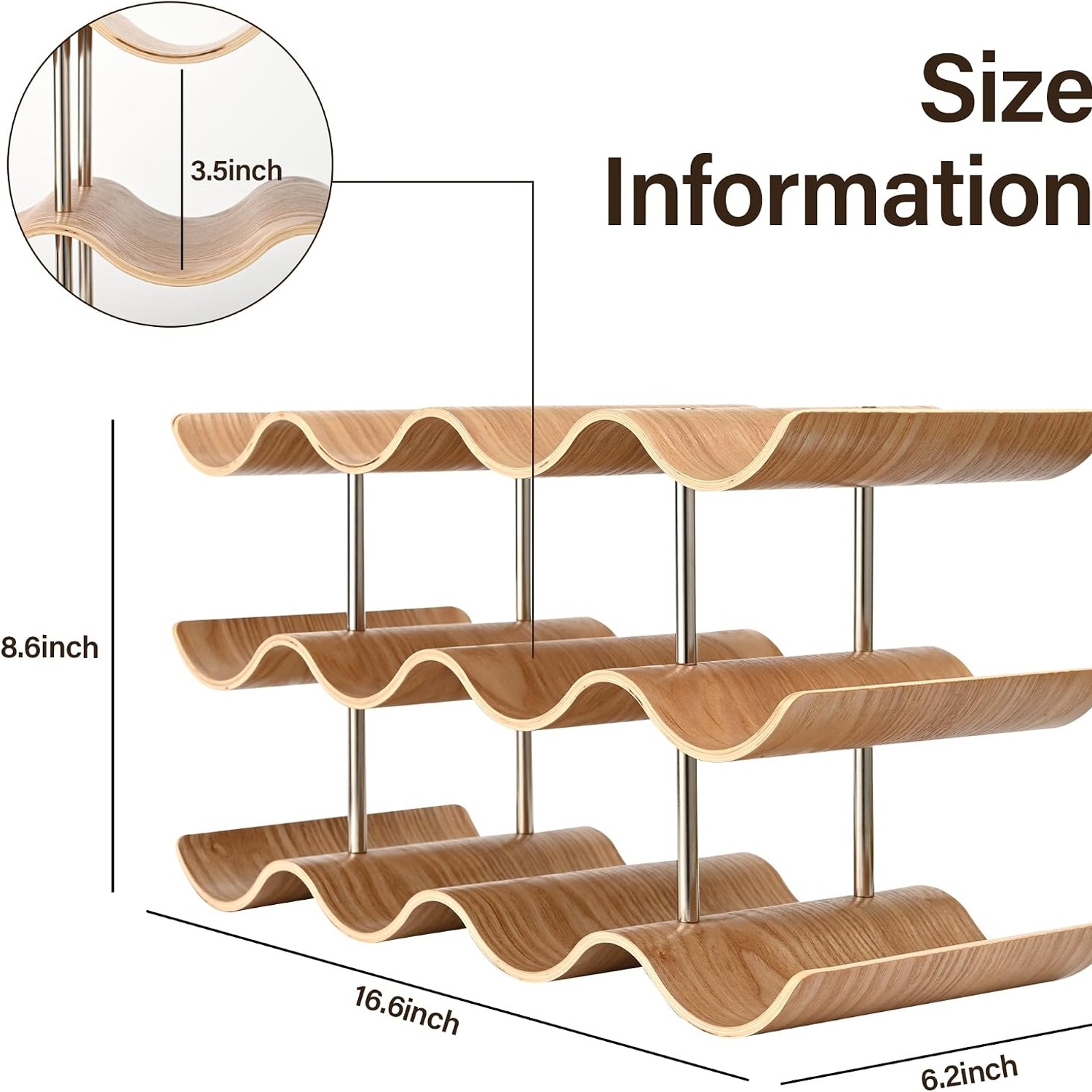
Small homes benefit most. At 42.2cm wide and 15.7cm deep, the footprint is smaller than most kitchen appliances. That makes it a sensible kitchen bench wine rack for apartments, units, rentals and the kind of galley kitchen where every centimetre is spoken for. You are using vertical space rather than spreading bottles sideways.
It also travels well between roles. Put it on the sideboard when guests come over. Move it to the bar cart for a party. Slide it onto a pantry shelf when the bench gets busy. At one kilogram empty, shifting it is no effort.
Who it does not suit: serious collectors. If you are laying down bottles to age for five or ten years, you need stable temperature, steady humidity and darkness. No open timber rack on a kitchen counter offers that. Keep this for the drinking stock and let the cellar or the wine fridge handle the long game.
How to choose a countertop rack
A few things are worth checking before you buy any rack, this one included.
Measure the height gap, not just the width. Most people check whether a rack fits along the bench and forget about the cupboard overhead. You need the rack height plus enough room to lift a bottle in and out at an angle. This rack is 21.8cm tall, so a gap of around 35cm or more makes life easy.
Count the oversized bottles you own. Capacity claims assume standard 750ml shapes. If half your collection is sparkling or chunky Shiraz bottles, a rack with only narrow slots will disappoint you. Four wider top slots here give you real room for the odd shapes.
Look at how the bottle is held. Flat shelves let bottles roll. Wire cradles can mark labels. Timber troughs with a polished surface strike a decent balance: the bottle sits still and the finish is smooth against glass.
Think about weight, both ways. A heavy rack is stable but annoying to move. A light rack is easy to move but depends on the bottles to anchor it. One kilogram sits on the light side, which is a plus if you like rearranging and a thing to be aware of if you have curious kids or pets at bench height.
Check what the frame is made of. Timber alone can flex. Timber with metal struts holds its shape under load. That combination is a good sign in any freestanding wine rack.
Living with it
Day to day, there is almost nothing to do.
Keep it out of direct sunlight. That is less about the rack and more about the wine, since UV ages bottles faster than almost anything else in a kitchen. The same goes for heat. Do not park it next to the oven, the dishwasher vent or a sunny window.
Wipe the timber with a dry cloth. That is the care instruction for this product and it covers most situations. If something sticky lands on it, a barely damp cloth and an immediate dry-off will do. What timber does not like is soaking, solvents and scouring pads.
Every few months, check the screws. Any assembled furniture settles a little with use, and a quarter turn on a loose screw keeps the frame tight. It takes thirty seconds.
When you move it, lift rather than drag. Dragging puts sideways force through the joints, and over time that is what loosens things.
A note on gifting
This lands well as a present, mostly because it fills an obvious gap. Anyone who likes wine already owns glasses, a corkscrew and probably a decanter they use twice a year. What they usually do not have is somewhere sensible to put the bottles.
Natural timber is also a safe bet visually. You are not guessing at whether it matches their colour scheme, because wood tends to sit comfortably with both light and dark kitchens. And since it ships flat, wrapping is a rectangle rather than a puzzle.
Housewarmings, birthdays, a thank you to the friend who always arrives with something good: all reasonable uses.
The short version
Twelve bottles, three wavy timber tiers, a footprint of roughly 42cm by 16cm, and a kilogram of weight. Eight slots below for standard bottles, four wider slots on top for the big ones. Wood and metal construction, polished finish, assembly in minutes with your own Phillips screwdriver.
It is not a cellar and it does not pretend to be one. What it does is take the bottles that are currently scattered around your kitchen and put them in one place where you can see them, reach them, and not knock them over. For most households, that is the whole job.
Measure the space, count your oversized bottles, and if the numbers work, this is an easy piece of modern wine storage to live with.